The right needle for the fabric: system, size and point
The needle packet carries three pieces of information: the system, the size and the point. Here's how to read them, with Schmetz's fabric-by-fabric guidance and the points where manufacturers disagree.
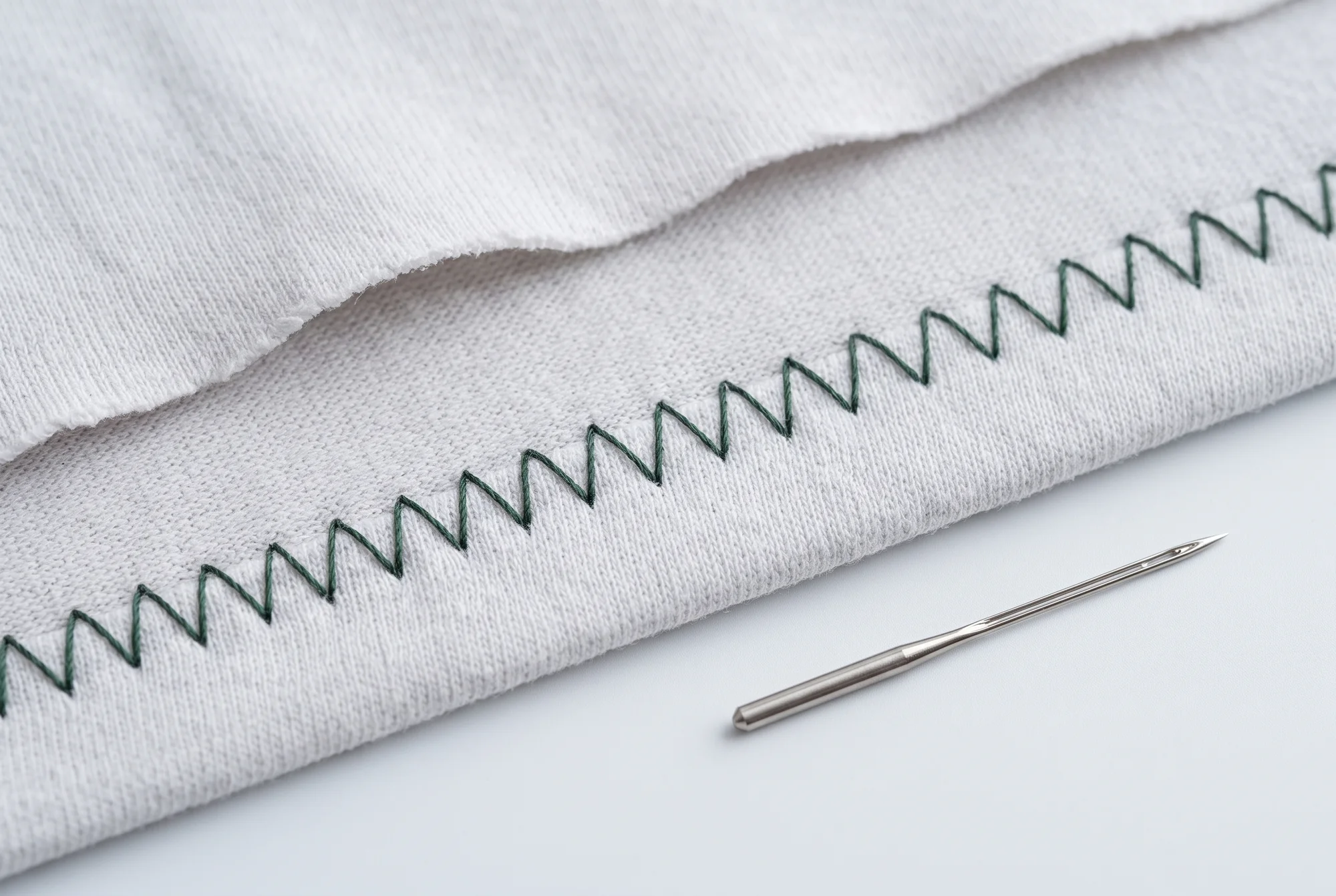
You've cut out a t-shirt in jersey, you sew it with whatever needle was already fitted on the machine, and every so often the seam skips a stitch; or the knit runs near the holes. Often it isn't the machine's fault: it's the needle. The packet carries three pieces of information, and that's all you need to choose: the system, the size, and the type, which above all means the shape of the point.
The system: 130/705 H
The system tells you whether a needle fits your machine. Domestic sewing machines use system 130/705 H: Schmetz writes that the needles in its Needle ABC, all of this system, fit domestic machines from every manufacturer. The same needle also appears under other codes, which Schmetz lists as equivalents: HAx1, 15x1, 705 H.
The upper part of the needle, the shaft, is what's clamped into the needle bar. It has a flat side, and Schmetz explains why: the needle always goes in the right position, and can't be fitted crooked. Janome's manuals say to insert it with the flat side facing the back, pushing it all the way up.
On the back, just above the eye (the hole the thread passes through), there's a notch called the scarf. It leaves room for the hook, which under the plate catches the needle thread and interlaces it with the bobbin thread. Janome explains that a longer, deeper scarf helps the hook catch the thread loop, and prevents skipped stitches; its ball-point needles for stretch fabrics, it adds, have a deeper scarf.
Not every machine uses this system. Schmetz warns that overlockers, long-arm machines and high-speed machines may call for different systems, such as ELx705, and points you to the machine's manual. In our catalogue, as of 19 September 2026, the three straight-stitch machines that state their needle system all state HLx5, and only one also 130/705 H. If your machine isn't a classic domestic model, check the manual before buying needles.
Size: the NM number
The size is written on the packet in two ways, for example 90/14. The first number is the NM, the metric size: Schmetz defines it as one hundred times the shaft diameter in millimetres, so an NM 90 has a 0.9 mm shaft. The second is the SIZE, common in English-speaking countries and in Asia. In both cases, the higher the number, the thicker the needle.
| NM | SIZE |
|---|---|
| 60 | 8 |
| 65 | 9 |
| 70 | 10 |
| 75 | 11 |
| 80 | 12 |
| 90 | 14 |
| 100 | 16 |
| 110 | 18 |
| 120 | 19 |
| 130 | 21 |
The size depends on the fabric, but also on the thread, which has to move freely through the eye. Schmetz suggests a test: thread the needle, hold the thread taut at roughly a 45-degree angle, and let go of the needle. If needle and thread are well matched, the needle slides slowly down the thread under its own weight.
For everyday sewing, Janome's manuals recommend an 11/75 or a 14/90: finer for lightweight fabrics, thicker for heavy ones, and always a test on a scrap of the same fabric.
The point: needle type
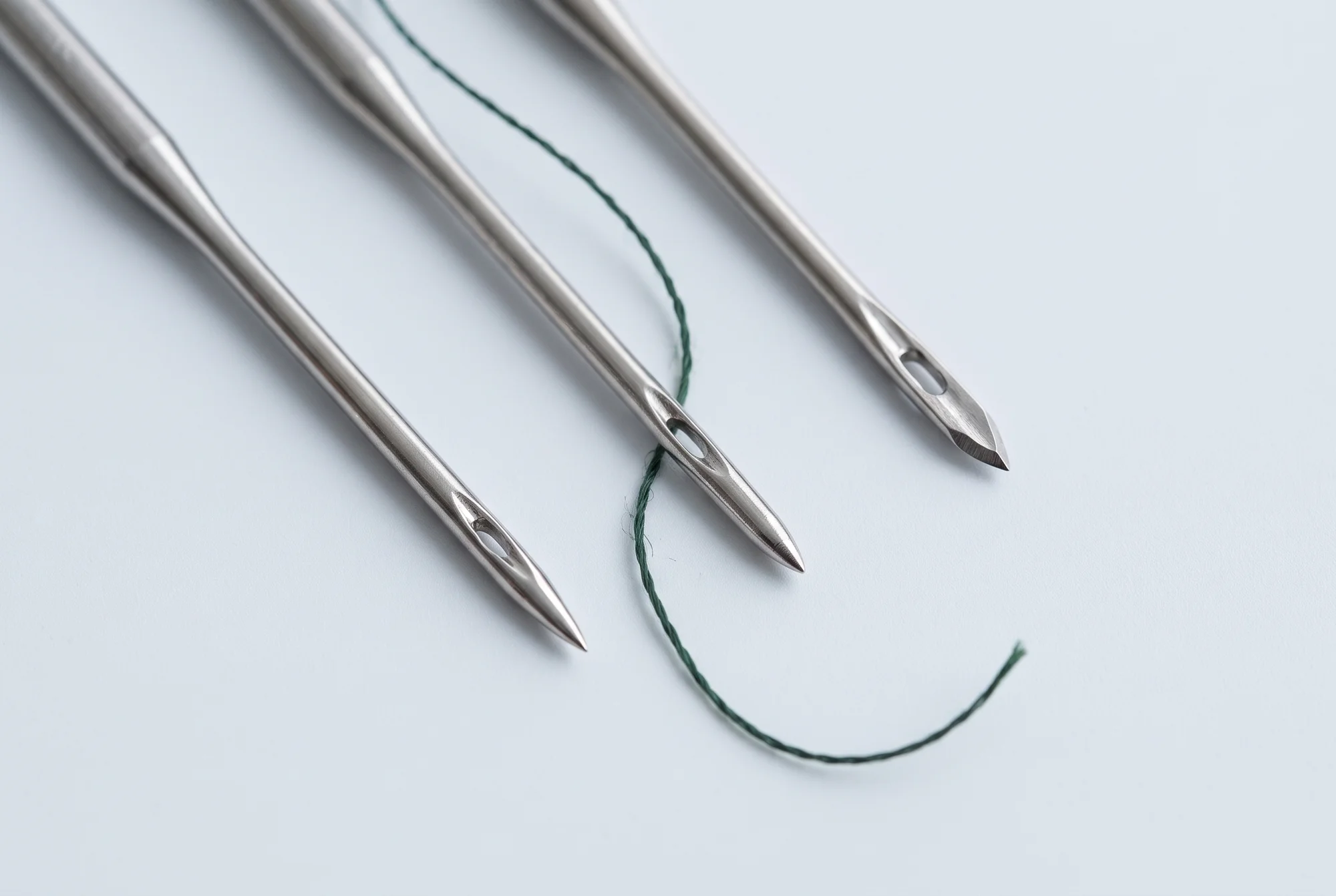
This is the choice that changes the result the most. On domestic needles, Schmetz uses just a few point shapes, and each needle type uses one:
| Point | What it does, according to Schmetz | Needles |
|---|---|---|
| Slightly rounded | The standard point: sews most materials without trouble | Universal, Topstitch, Metallic |
| Slim, slightly rounded | Enters delicate fabrics gently | Quilting, Black Super Fine |
| Slim acute | Pierces tightly woven and coated fabrics precisely, and reduces puckering | Microtex |
| Medium ball point | Pushes threads and loops aside and slips into the gaps between them, without damaging the fabric | Jersey, Stretch, Jeans, Embroidery |
| Cutting, DH or LL | Cuts through leather to enter it more easily | Leather DH, Leather LL |
Beyond the point, needles also differ in the eye: the Topstitch and Metallic have a 2 mm eye, for thick, doubled or metallic threads; the Embroidery needle has a wider one, for embroidery thread. And they differ in the shaft: the Stretch has a shaft, eye and scarf designed against skipped stitches on very elastic knits, the Jeans a shaft that bends less in thick fabrics.
On leather needles Schmetz puts a warning: they shouldn't be used on woven or knit fabrics. The cut that's needed to enter leather ruins ordinary fabric.
Fabric by fabric
Schmetz's Needle ABC closes with a list of fabrics, each with its recommended needle and sizes. Here's a selection:
| Fabric | Needle and sizes recommended by Schmetz |
|---|---|
| Batiste | Universal or Black Super Fine, 60–70 |
| Poplin | Microtex or Universal, 60–80; Black Super Fine, 60–70 |
| Linen | Universal, 80–90 |
| Silk | Black Super Fine, 60–70; Microtex, 60–90 |
| Wool and wool blends | Universal, 70–100 |
| Denim | Jeans, 70–110 |
| Canvas | Jeans or Universal, 90–110 |
| Jersey | Jersey, 70–80; Stretch, 65–75, for elastic knits |
| Sweatshirt fleece | Jersey, 70–90; Stretch, 75–90 |
| Very stretchy knit, with elastane | Stretch, 65–75 |
| Soft faux leather | Microtex or Universal, 70–100 |
| Thin leather | Leather LL or Microtex, 70–90 |
| Thick leather | Leather LL, 100–120, for decorative slanted-point seams; Leather DH, 100, for straight seams |
Schmetz itself warns that materials vary a lot and that these are general guidelines: before you start, test the needle on a scrap. The encyclopedia entries on jersey, denim, linen and leather draw on this same data.
Where manufacturers disagree
Machine makers and needle makers don't always give the same guidance.
- Jersey. Schmetz recommends the Jersey needle in sizes 70 and 80. Brother's support site, for stretch fabrics, recommends a 90/14 ball-point needle.
- Denim. Schmetz fits its Jeans needle with a medium ball point. Janome's needle guide describes its denim needle as having a sharp point.
- Stretch and fine fabrics. For elastic knits, very fine fabrics and synthetics, Janome's manuals recommend one of its own needles, blue-tipped, in size 11: Janome says it designed it for its own machines.
There's no rule that satisfies everyone. Start from your machine's manual and the needle maker's table, and decide with a test on a scrap.
Colours on the needle
Schmetz needles carry two coloured bands near the top: the first shows the type, the second the size. They're there to identify a needle once it's out of its packet. Other manufacturers use their own colours, which don't match Schmetz's: Janome's blue tip is one example.
When to change it
A worn needle causes the same problems as the wrong one. Schmetz lists frayed or broken thread, skipped or uneven stitches, puckering, damaged fabric, and a sharp popping sound at every stitch, and recommends changing it after about eight hours of sewing, or at the start of every new project. We cover this in when to change your needle; if the problem is skipped stitches, start from thread nests and skipped stitches.
In brief
- Check the system in the manual: it's almost always 130/705 H, but not on every machine.
- Choose the point from the fabric: slightly rounded for woven fabrics, ball point for knits, slim acute for tightly woven and coated fabrics, cutting only for leather.
- Choose the size from the fabric's weight and the thread's thickness, and check it with the 45-degree test.
- Test on a scrap. If something's off, change the needle before touching the tension.
Sources
- Schmetz, Needle ABC. Needles for household sewing machines, edition 03/2024 — Source 1
- Schmetz, «Point shapes» — Source 2
- Schmetz, «Needle anatomy» — Source 3
- Schmetz, «Needle systems for overlock machines» — Source 4
- Janome, «Needle Selection Guide» — Source 5
- Janome, instruction manual DC5100 — Source 6
- Brother USA, «Needle type for stretch fabrics» — Source 7
Three examples from the catalogue
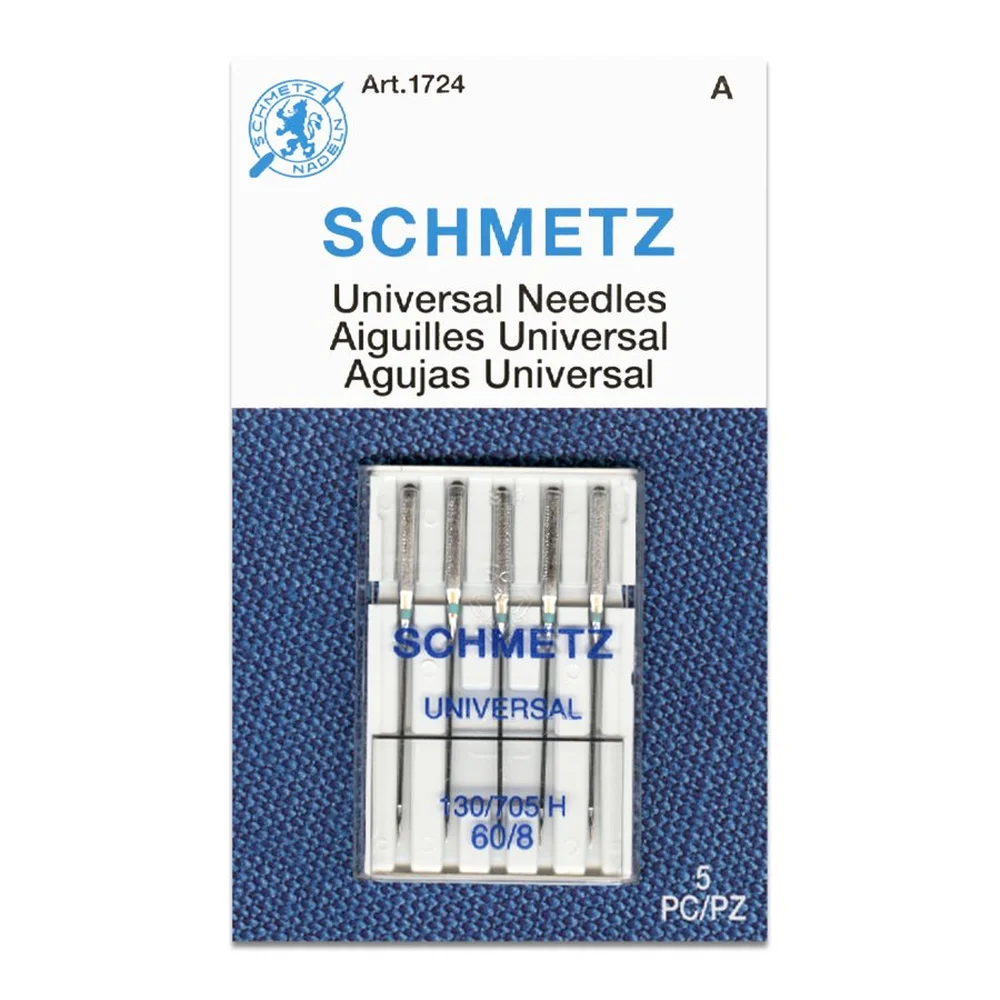
Why it's here Needle type: Universal · manufacturer's source
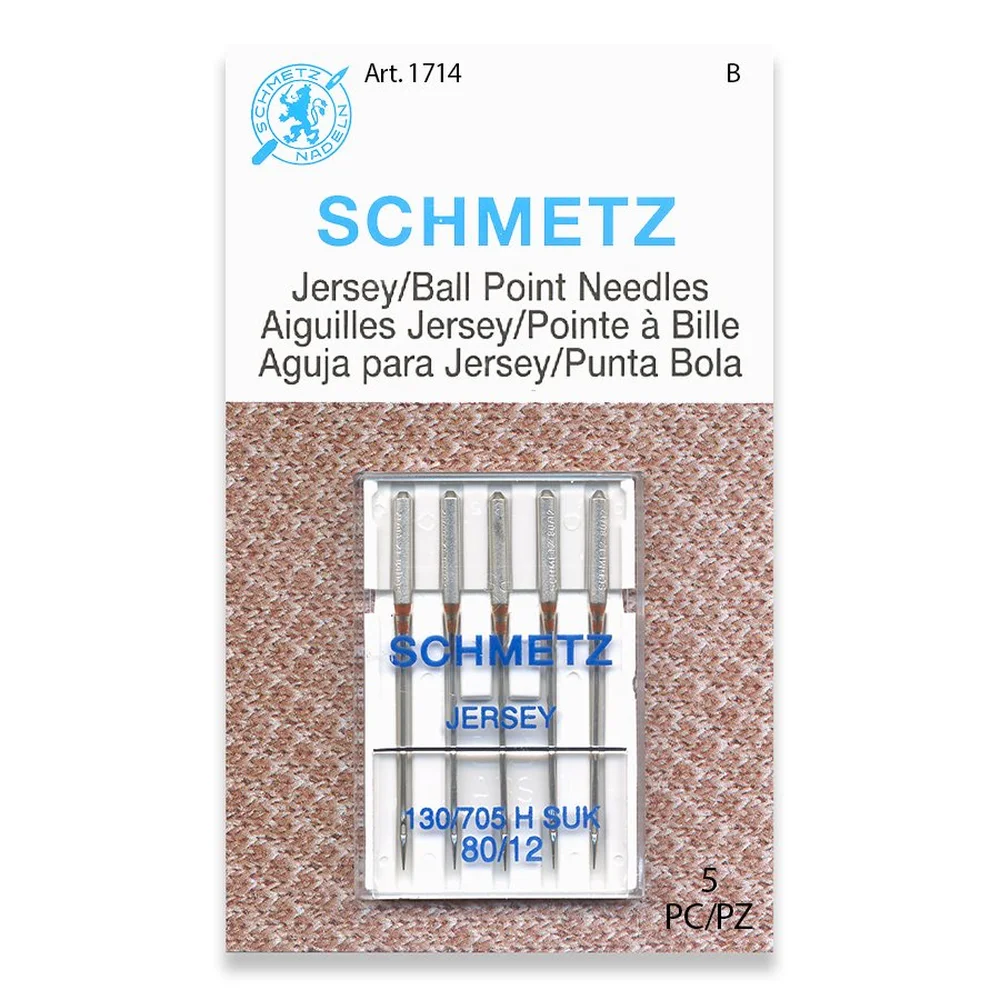
Why it's here Needle type: Jersey (ballpoint) · manufacturer's source
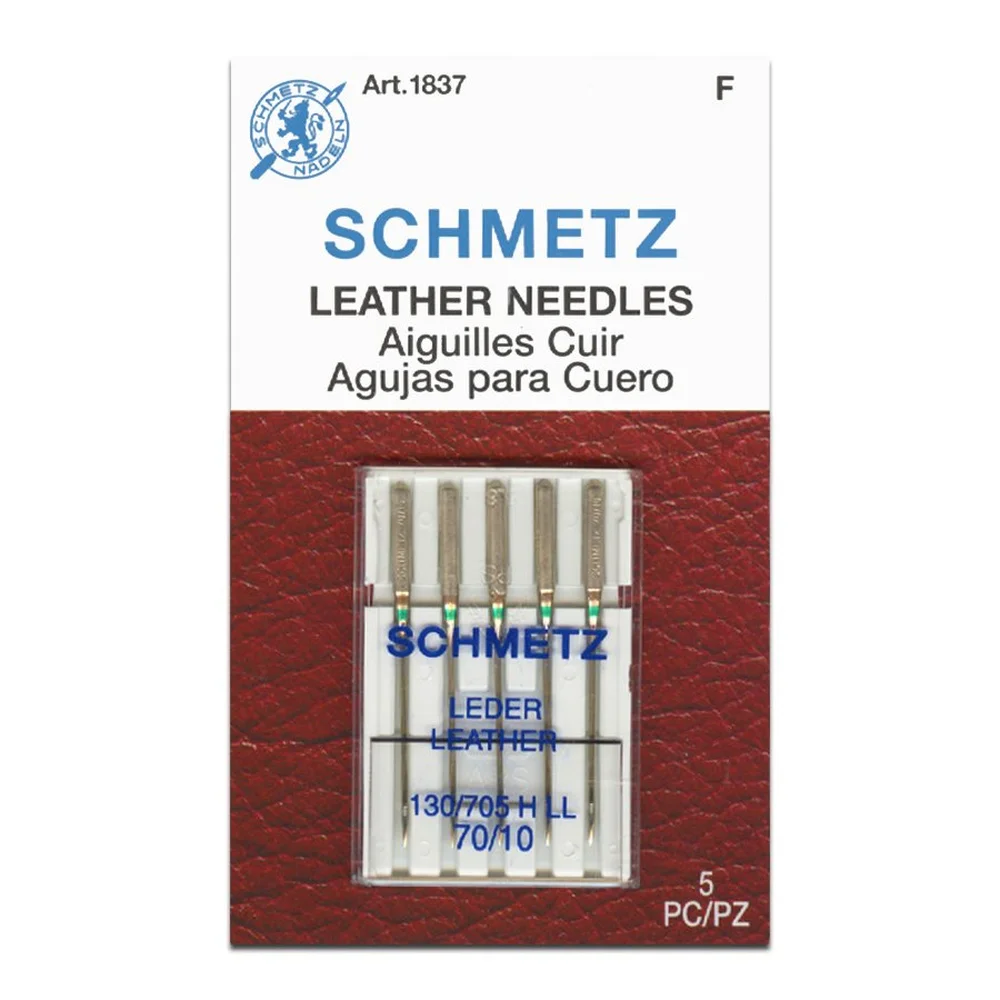
Why it's here Needle type: Leather · manufacturer's source