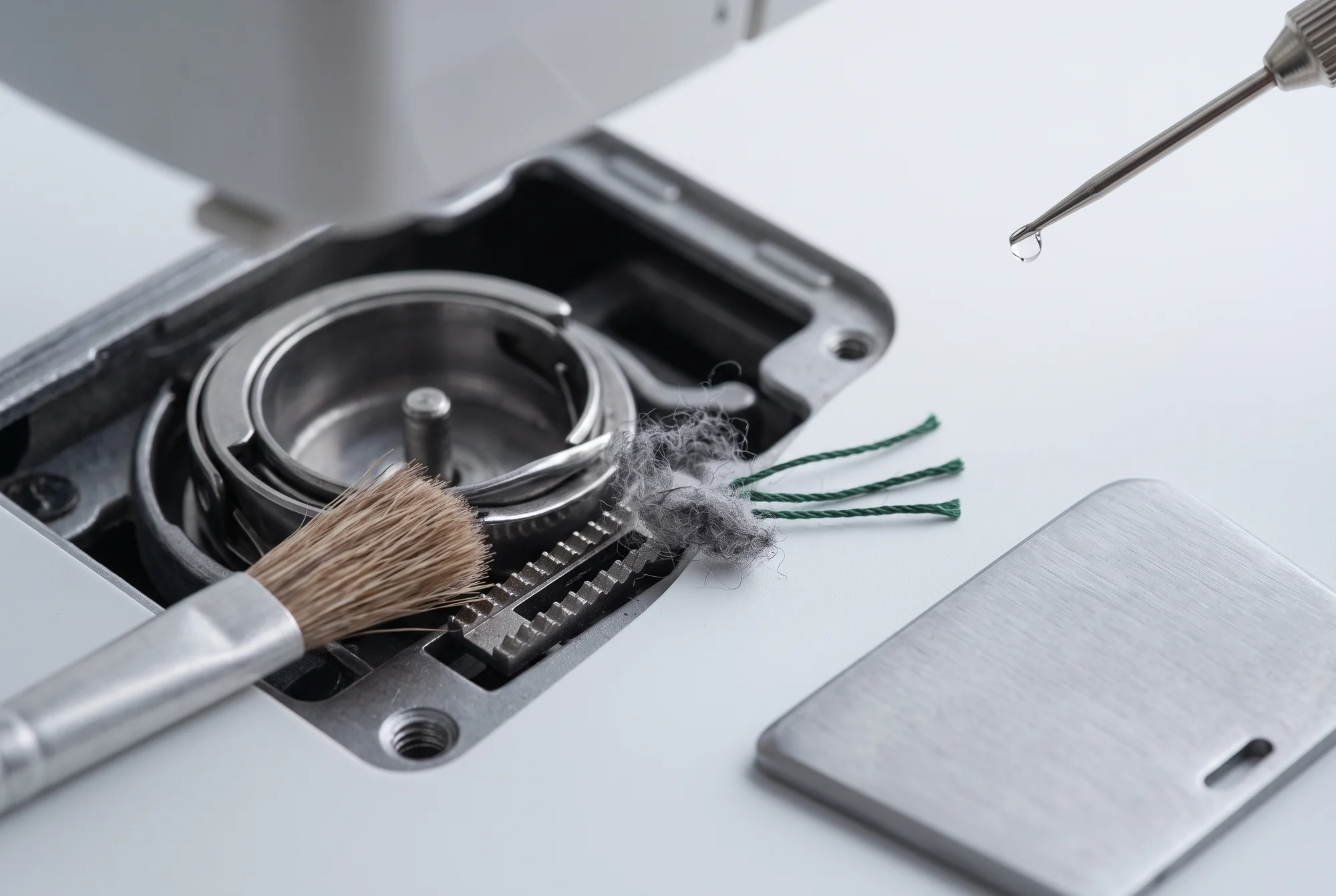
When to change your sewing machine needle
A worn needle isn't visible to the naked eye, but you can see it in the stitching and hear it in the sound. The signs to recognise and the practical rule given by Schmetz and the machine manuals.
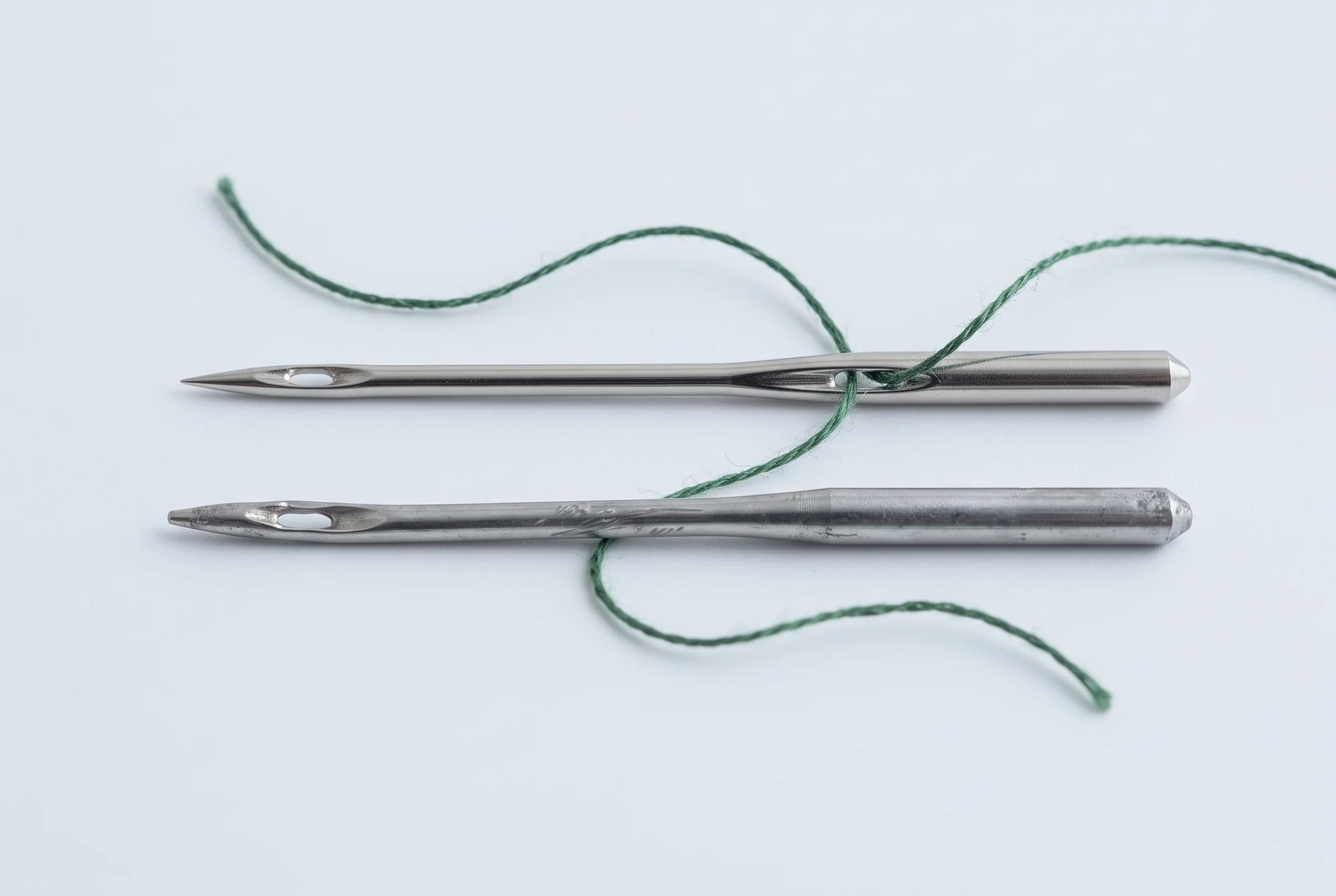
The thread frays, a stitch is skipped now and then, the machine makes a small sharp pop at every pass. Before touching the tension, look at the needle: it's the cheapest part, and the one that works hardest. Schmetz, the German needle manufacturer, opens its guide to needles for domestic machines with a line that stands as a rule: your sewing machine is only as good as the needle you use.
Why a needle wears out
With every stitch the needle passes through the fabric. The point, the tip that enters the cloth, gets dull; the eye, the hole the thread passes through, works against the thread at every stitch. Then there are accidents: a pin, a zip, fabric pulled while sewing. Juki explains in its manual that pulling or pushing the fabric while the machine sews flexes the needle and can break it.
At first, wear isn't visible to the naked eye. That's why manufacturers give you two tools: a list of signs, and a rule of thumb for timing.
The signs
In the 2024 Needle ABC, Schmetz lists what happens when a needle is worn or damaged:
| Sign | What you see or hear |
|---|---|
| Frayed or broken thread | The needle thread splits into fibres or snaps |
| Skipped or uneven stitches | Stretches where the needle thread doesn't interlace with the bobbin thread |
| Puckered seam | The seam gathers and puckers the fabric |
| Damaged fabric | Holes, pulled threads, runs |
| Noise | A sharp pop every time the needle goes through |
Machine manuals say the same thing in their troubleshooting tables. Janome, Elna, Bernina and Singer list a "bent or blunt" needle among the causes of broken thread, skipped or uneven stitches, and a needle snapping, and the fix is always the same: change it. Pfaff and Singer add that a damaged needle can also ruin the needle plate. Elna warns that runs in knits, silks and silk-like fabrics are permanent, and are often caused by a damaged needle: on these fabrics, the damage can't be undone.
The practical rule: eight hours, or one needle per project
On this, manufacturers are close, but not identical:
- Schmetz recommends changing the needle after about 8 hours of sewing, or, as an easy alternative to remember, at the start of every new project;
- the Singer and Pfaff manuals recommend a new needle every 6–8 hours of actual sewing;
- Janome and Elna give no number of hours: they ask you to check the needle often and never use it blunt or bent.
The hours mean actual sewing time, with the needle running, not time spent sitting at the machine.
Two tests you can do yourself
The tights test. Schmetz suggests passing the needle through an old pair of sheer tights: if it snags or pulls the threads going in or out, the point is damaged and the needle shouldn't be used again.
The flat-surface test. Janome and Elna explain how to check whether a needle is straight: rest the flat side of the shaft, the upper part of the needle that goes into the clamp, on a flat surface such as the needle plate or a piece of glass. The gap between the needle and the surface should be even along its whole length; if it isn't, the needle is bent.
Neither test replaces the time-based rule: a needle can pass both and still have a scored eye.
Fitting the new needle correctly
A new needle fitted incorrectly gives the same symptoms as a worn one: in Janome's troubleshooting tables, "needle inserted incorrectly" sits right next to "needle bent or blunt." Janome's manual describes the motion: with the machine off, loosen the clamp screw, insert the needle with the flat side of the shaft facing the back, push it up as far as it will go, and tighten the screw firmly. Bernina and Elna also want the flat side facing the back; if your manual says otherwise, follow the manual.
Needles for domestic machines use system 130/705 H, and Schmetz writes that the ones in its guide fit domestic machines from every manufacturer. Some semi-professional machines accept other systems too (the manual for a Juki straight-stitch machine lists HAx1 or HLx5): check the manual before buying a box of needles.
Coated needles: they last longer, but still need changing
Schmetz distinguishes three coatings. The standard one protects the needle from corrosion and wear in everyday sewing. The GOLD line, with a harder gold-toned coating, is designed for heavy use and for demanding, heavyweight fabrics: according to Schmetz it lasts longer and needs replacing less often. The BLACK line, non-stick, is for delicate fabrics and adhesive materials, and reduces skipped stitches and thread breakage.
It isn't always a worn needle
Even a new needle, if it's the wrong one, gives the same symptoms. The size also has to be chosen based on the thread: Schmetz suggests holding the threaded needle at roughly a 45-degree angle; if needle and thread are well matched, the needle slides slowly down the thread under its own weight. The point has to be chosen based on the fabric: a ball point for knits like jersey, a reinforced point for denim. How to choose is explained in The right needle for the fabric.
If the symptoms remain even with a new, suitable needle, the problem lies elsewhere: threading, tension or lint. Follow the order in Thread nests and skipped stitches and, for cleaning, Cleaning and oiling your sewing machine.
In brief
- Change the needle every 6–8 hours of actual sewing, or with every new project.
- Change it right away if the thread frays, if it skips stitches, if you hear a pop at every stitch, or if the needle has hit a pin.
- Never use a bent or blunt needle: on knits and silks, the damage to the fabric is permanent.
- Fit it all the way up, with the flat side where the manual wants it.
- If a new needle doesn't fix it, look for the cause elsewhere.
Sources
- SCHMETZ, Needle ABC — Needles for household sewing machines, edition 03/2024 — Source 1
- SINGER, manual HD 4523 — Source 2
- PFAFF, manual expression 715 — Source 3
- Janome, instruction booklet DC 3050 — Source 4
- Elna, instruction booklet 3210/3230 — Source 5
- BERNINA, user manual 570 QE (2023) — Source 6
- JUKI, manual HZL-HT740 — Source 7
- JUKI, manual TL-2010Q — Source 8
Three examples from the catalogue
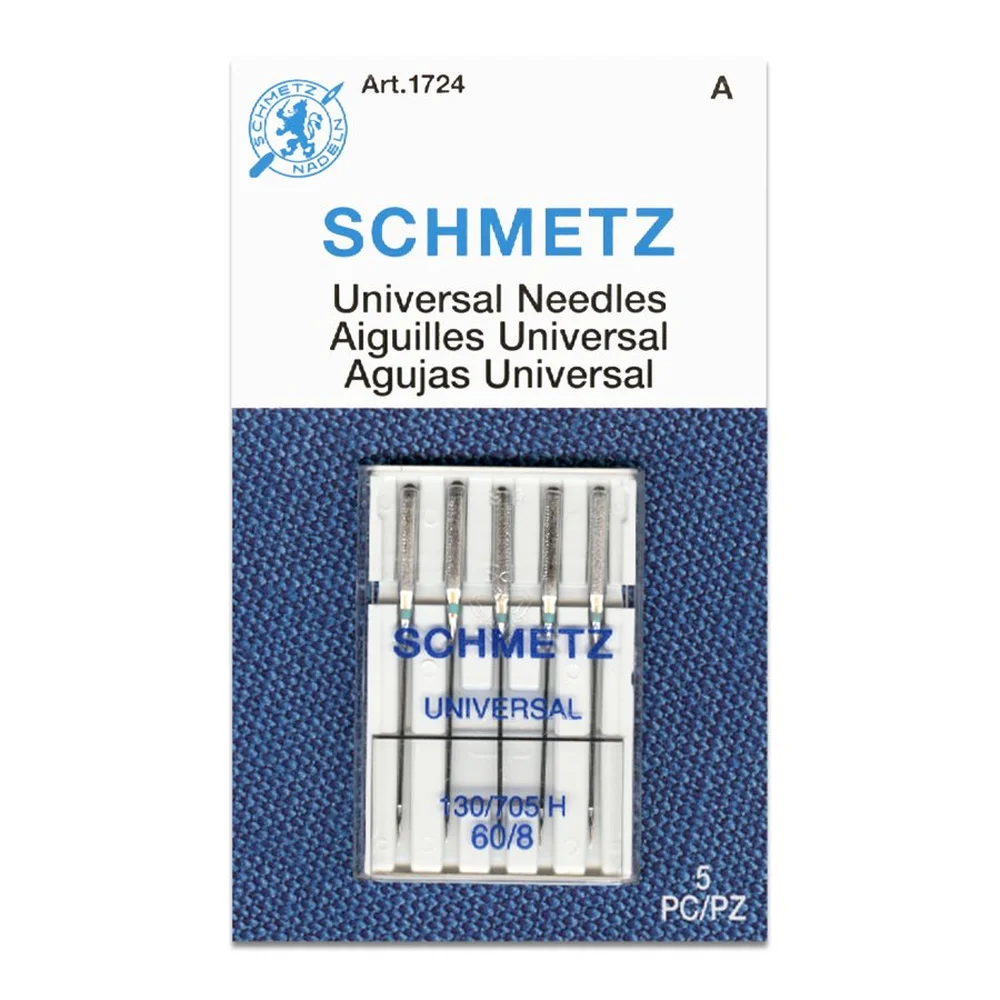
Why it's here Needle type: Universal · manufacturer's source
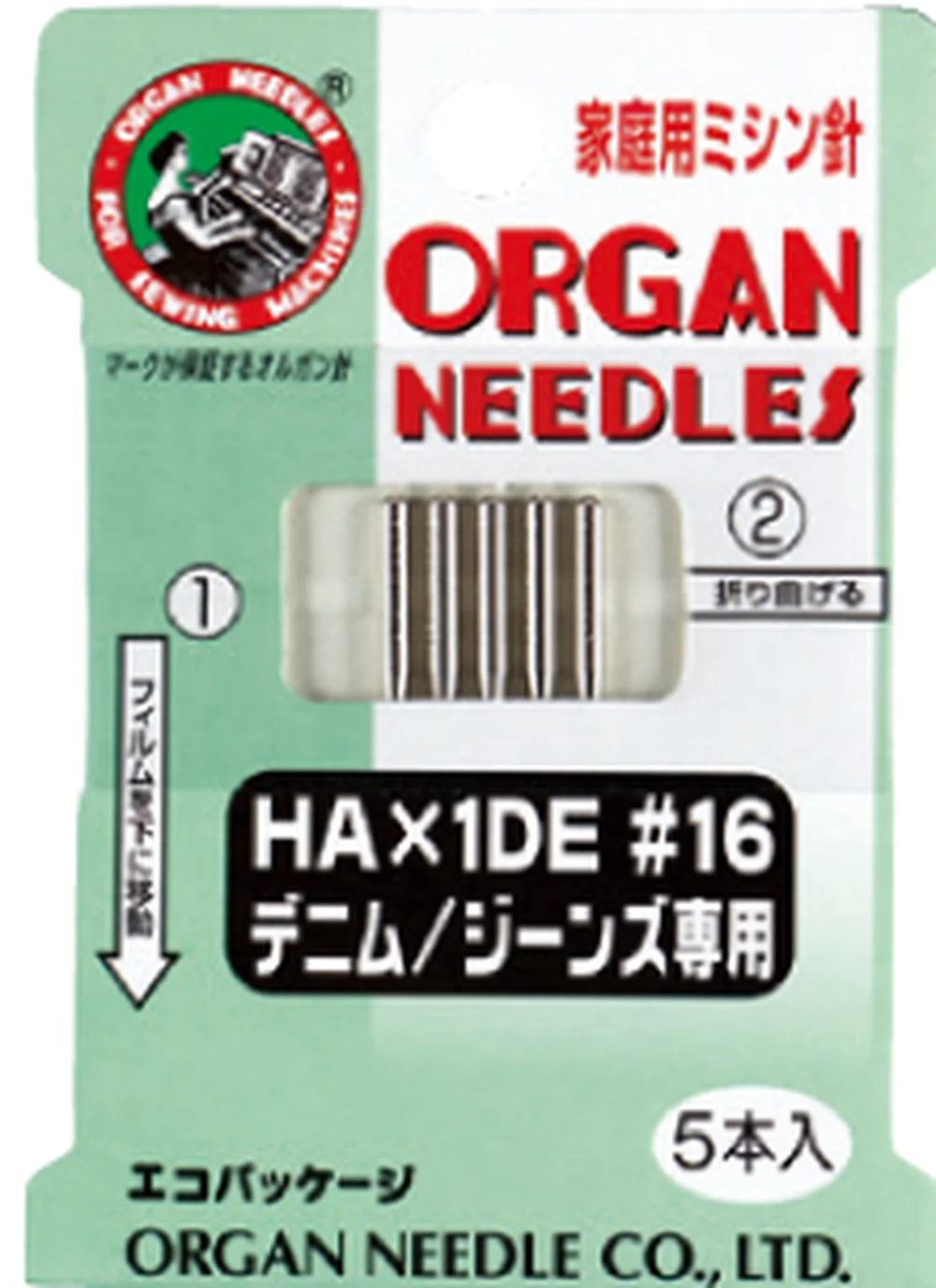
Why it's here Needle type: Jeans/Denim · manufacturer's source
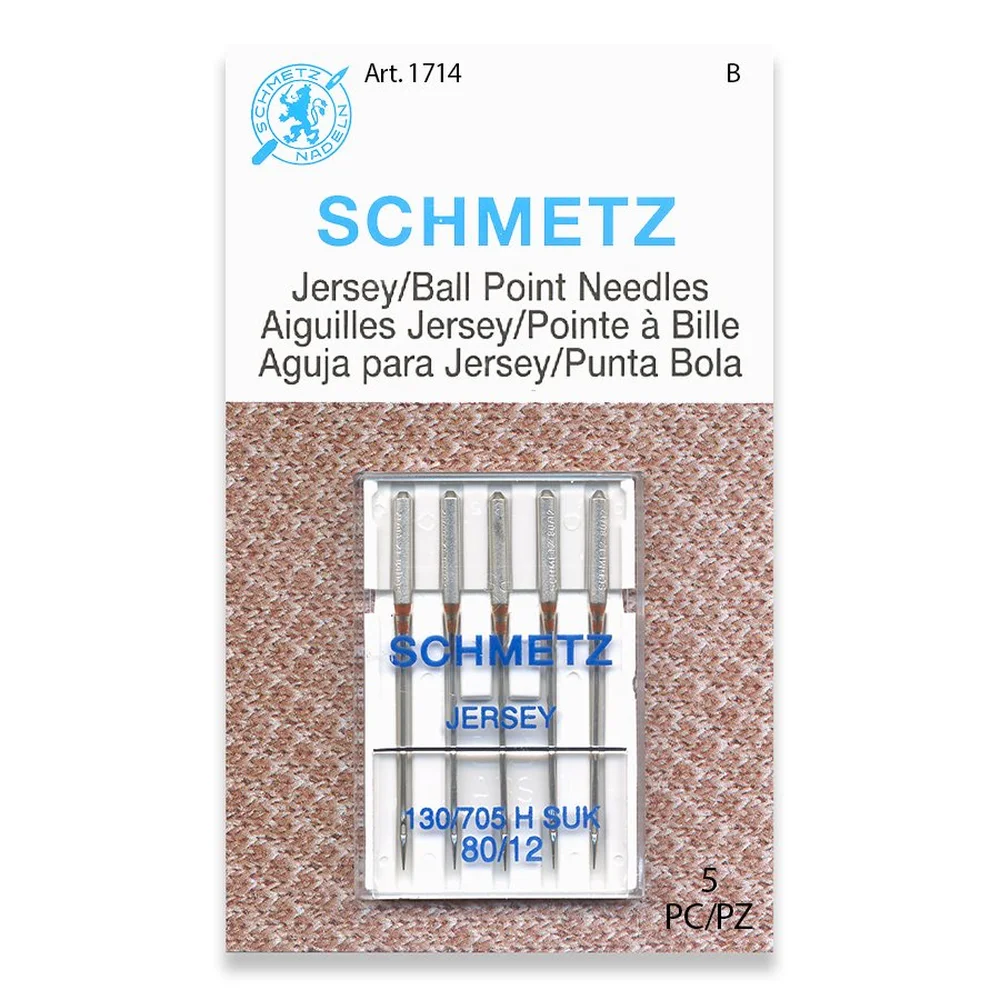
Why it's here Needle type: Jersey (ballpoint) · manufacturer's source